During a writers group meeting, one reviewer commented that my vocabulary was way too advanced for the average reader. Said comment brings up a number of issues--how do you determine reading level, how do you determine what reading level you should be targeting for your book, and what reading level is appropriate for your audience. I will use my book in progress Rough Riding in the White House: The Adventures of the Pony Algonquin and the Roosevelt Children as an example.
Determining Reading Level of Your Writing
If you are using Microsoft Word, you can easily determine the approximate grade level of your prose. In MSWord 2013:
Select the Review tab.
- Click on "Spelling & Grammar."
- Go through the spell check process.
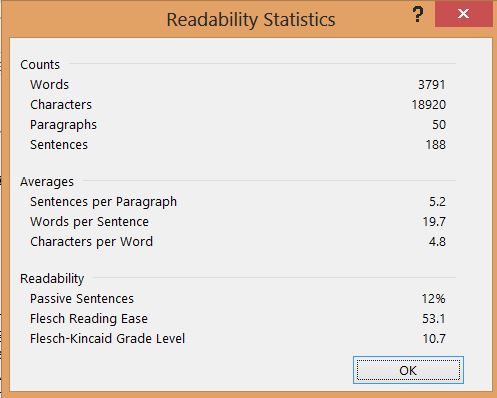
- The last screen shows Readability Statistics that includes percent passive sentences, Flesh Reading Ease, and Flesh-Kincaid Grade Level.
The Flesch-Kincaid Scale, shortened to the "F-K Scale (no I did not make that up), assesses the readability of documents. Working for the US Navy, Rudolf Flesch and Peter Kincaid developed the F-K formula to determine reading grade level of technical manuals in an attempt to simplify reading ease. Corporate, educational, and government organizations have also used the formula for similar purposes. For example, the state of Pennsylvania mandated that all auto insurance policies need to be written at a maximum 9th grade reading level. The F-K formula is based on average number of words per sentence and average number of syllables in the words. It does not consider vocabulary level, maturity level of topics, or intellectual complexity of ideas.
The above screen shows data for my first chapter of my book. Grade level is 10.7. My intended audience is adult readers on historical biographies. So is my prose too high or low for the intended readers?
Determining Targeted Reading Level for Your Book
Internet sites such as Lexile and ATOS enable you to look up reading levels of books. Lexile was developed by A.J. Stenner and Malbert Smith for MetaMetrics. Lexile also uses a formula based on sentence and word length with no allowance for maturity level of content. Lexile is probably the most familiar system since many school districts use Lexile scores in relation to books selected for their common core educational programs.
You can look up Lexile scores for books at https://fab.lexile.com
Let's go back to my book in progress
Rough Riding Through the White House. My targeted audience are those people who read historic nonfiction such as
Unbroken by Laura Hillenbrand and
Dead Wake: The Last Crossing of the Lusitania by Erik Larson. As you can see below,
Dead Wake scores 1190L;
Unbroken, 1010L.
You'll note that Lexile does not directly translate their scores into reading level by grade since their thinking is that students in the same grade vary in their reading level. However, if you search the internet you can find charts that correlate a range of Lexile scores into grade reading level. Here's a link to a simplified version of the conversion chart.
https://support.newsela.com/hc/en-us/articles/201218865-Grade-to-Lexile-Conversion-Table
Per this table,
Dead Wake is written at a 9th or 10th grade reading level and
Unbroken is at the top of the 6th grade reading scale. Different books by the same author will usually vary by reading level.
More scholarly works score even higher. For instance, David McCullough, who wrote the biography of Theodore Roosevelt
Mornings on Horseback, usually writes at a Lexile Level of 1300L or senior high school/beginning college. Theodore Roosevelt himself in his works
Ranch Life and the Hunting Trail and
The Rough Riders wrote at a college or post graduate level. Interestingly, the more I quote TR, the higher the reading level of my book.
What Reading Level is Appropriate for Your Audience
So, as far as I can tell, the current reading level of my book is within the target ranges of similar books for my selected audience--serious readers of non-fiction history. And reading level can be adjusted upwards or downwards when the book is finished. But since F-K scale does not address vocabulary level, this is still an open question.
Targeting a specific reading level may be a bit misleading for the writer of adult fiction as shown by the following Lexile scores for some famous novels. Note different reading level determination methods can produce widely differing estimates of reading level--as much as three grade levels. Swannenflugel, PhD, and Knapp, PhD, present some of the controversies of assigning books to students via reading level in their article "Three Myths about 'Reading Levels'" accessible via this link.
https://www.psychologytoday.com/blog/reading-minds/201702/three-myths-about-reading-levels
The following list shows the varied Lexile reading levels of popular children's books vs. some famous literary classics.
JK Rowling HP & Cursed Child 500L 2nd/3rd grade
Ernest Hemingway The Sun Also Rises 610L 3rd grade
E. B. White Charlotte's Web 680L 4th grade
Stephenie Meyers Twilight 720L 4th grade
William Faulkner As I Lay Dying 870L 5th grade
JK Rowling HP &Order of the Phoenix 950L 6th grade
Reading level itself does not determine appeal or comprehensibility or popularity of text to the reader. Nor does it address quality. In writing about history, Theodore Roosevelt explains, "Many learned people seem to feel that the quality of readableness in a
book is one which warrants suspicion. Indeed, not a few learned people
seem to feel that the fact that a book is interesting is proof that it
is shallow....[The memorable historian] has vision and imagination, the power to grasp what is
essential and to reject the infinitely more numerous nonessentials, the
power to embody ghosts, to put flesh and blood on dry bones, to make
dead men living before our eyes. In short he must have the power to take
the science of history and turn it into literature."
Source:https://www.historians.org/about-aha-and-membership/aha-history-and-archives/presidential-addresses/theodore-roosevelt