Nonfiction Publications

Theodore Roosevelt

Riding with Theodore Roosevelt in Equus, April 2018.

  • Republished by Equus online September 20, 2023.
  • Republished by Equus online January 8, 2025.
 
2025 Finalist Pacific Northwest Writers Association 
 

 The first chapter of my book Raising Heroes in the White House 1901-1909: Theodore Roosevelt and his Youngest Sons Archie and Quentin was a finalist in the Memoir/Nonfiction category.   I believe in the 70 years of this competition, it was the first time a biography made the list.  Of course, it may have been the first time a biography was submitted.  The other 12 categories are all fiction so I am especially proud the recognition.  Thank you PNWA.

 https://www.pnwa.org/page/Finalists2025


 Family History

The Lost Vowel in The Fourth River run by the Chatham University MFA program.  This is one of the pieces of which I am most proud.

https://www.thefourthriver.com/tributaries-newnature/2021/5/26/the-lost-vowel

The Lost Vowel  (longer version) in Scrawl Winter, 2023.

Krie Eleison in  LogoSophia at Christmas, 2022. 

Catch and Release in Glint Literary Journal in Winter, 2023

Horses in History

Detecting Icelandic Horse Origins USIHC Quarterly.

  • Cited twice in the Wikipedia Article on "The Icelandic Horse" which is identified as "one of the best articles produced by the Wikipedia community" and flagged as of high importance to the WikiProject Iceland and medium importance to the WikiProject Equine. 
  • Cited in Wikipedia article on the "Mongolian Horse." 
  • Published in USIHC Quarterly Linked to from Nortland Horse Web Site in Norway 
  •  Cited in "A Scientific and Historical Investigation on Mongolian Horses" in a Russian publication http://historic-journal.ru/2017/scientific-and-historical-investigation-on-mongolian-horses/. 
  • Cited in "The Roles of Humans in Horse Distribution" by Sandra Olsen, pp. 105-120, in the book Wild Equids: Ecology, Management, and Conservation edited by Jason I. Ransom, Petra Kaczensky, John Hopkins University Press, May 15, 2016 
  • Cited in "Spotted phenotypes in horses lost attractiveness in Middle Ages" by Wutke, S., et al. in Scientific Reports 6:38548 · December 2016 https://www.researchgate.net/publication/311500236_Spotted_phenotypes_in_horses_lost_attractiveness_in_the_Middle_Ages 
  • Cited in "International Horse People 500 AD" by Katarina Lundgren, MiMer Centre, Equine Human Education and Research Centre, August 29, 2020 
  • Cited by C. Arnett in "Hestaping (Horse Meetings) in Medieval Icelandic Culture," p. 190 in Pleasure and Leisure in the Middle Ages and Early Modern Age, Walter de Gruyter GmbH & Co KG, Aug 5, 2019. 
  •  Cited by E. Konopka in "Of Horses and Men Symbolic Value of Horse in Icelandic Art," Zoophilologica. Polish Journal of Animal Studies, June 2020. Saskia Wutke,
  • "Tracing Changes in Space and Time: Paternal Diversity and Phenotypic Traits during Horse Domestication," November 2016, University of Eastern Finland Thesis. 
  • Mentioned in Kristina Stelter, "The Horse of the Vikings," Academia, https://www.academia.edu/31039786/
  • The_Horse_of_the_Vikings Konopka, Emiliana. "O koniach i ludziach. Symboliczne znaczenie konia w sztuce islandzkiej." Nr 6 (2020): Zoophilologica - T.6 (2020) 
  • Cited in Huizinga and Callois, "Pleasure and Leisure in the Middle Ages," 2019, Dokumen.Pub

Jules Verne and the Icelandic Horse USIHC Quarterly, p. 39

Icelandic Pony in William Morris' Kitchen Blessiblog 


Equine Heath


Case Study:  Blessi's Mysterious Nosebleed        Equus       September 2018.


Beating the Odds: The Astonishing Survival of Icelandic Horse Twins  The Northwest Horse Source,

  • Also published in the North American Icelandic Horse Stud Book.


What is Bone Spavin?       USIHC Quarterly,
  • Translated into French by Alexandra Russ and published as "Qu'est-ce Que L'Eparvin" in Les Crinieres Islandaises.  September 2014

Spots in the Eyes (MCOA)   USIHC Quarterly


  • This article is cited Kristina Stelter's "The Horse of the Vikings"  in Icelandic Horse Quarterly 2016. https://www.academia.edu/31039786/The_Horse_of_the_Vikings
Laminitis                         USIHC Quarterly, p. 33

  • My article on laminitis is also cited in the USIHC Riding Badge Program.

Horse Humor


Sitting Pretty,      Equus Magazine     September, 2017, p. 80.
Sitting Pretty,      Equus On-line,  December 1, 2017 

Jousting for Success      USIHC Quarterly, p. 37  


The Donut Effect  Behind the Bit (Online)  August 2018

Blessi Has a Bad Hair Day   USIHC Quarterly, p. 29 

Grass, Grass Everywhere Nor Any Bite to Eat    USIHC Quarterly

Icelandic Horses


Fun with World Fengur     USIHC Quarterly, p. 20    


There is no Tolt in Dressage   USIHC Quarterly, p. 32  
  • Also published in Canada by the Canadian Icelandic Horse Organization

The Extremes of Extreme Farm    USIHC Quarterly, p. 29  
  • Also published in Canada by the Canadian Icelandic Horse Organization

Introduction to Conformation      USIHC Quarterly, p. 18  

United States Icelandic Horse Congress Marketing Brochure


Horse Training


A Debate about Round Penning   (ed.)  USIHC Quarterly, p. 23 


Principles of Horse Learning          USIHC Quarterly, p. 38 


 Craft of Writing

What Do We Learn About Writing from Murder Hornets  in  Black Fox Literary Magazine
A Pocketful of Words  in  Black Fox Literary Magazine

Character Creation Is Not a Crystal Growing Kit       Page and Spine Fiction Showcase

 Why Do We Write in Page and Spine Fiction
https://pagespineficshowcase.com/pamela-nolf.html


Twitter Comment - Retribution of the Deadwooders


There is a twitter posting about the newly published Undead, a collection of horror short stories from Planispher Q publishers.  My "Retribution of the Deadwooders"   is the only story receiving an individual comment. "Que graaaande" means "how greeaat" in French.

The book has lots of great horror stories.  You can get a copy at 

https://www.lulu.com/shop/planisphere-q/planisphere-q-undead/paperback/product-m84795.html?page=1&pageSize=4


"Retribution of the Deadwooders" Published


Planisphere Q has published "Retribution of the  Deadwooders" in the 2022 Fall edition with the theme of the "Undead."  You can obtain a copy from Lulu.com.

Retribution of the Deadwooders Accepted

Planisphere Quarterly has accepted my flash fiction "Retribution of the
Deadwooders" to be published in its Undead Issue  in October.  The story is a bit naughty.

Catch and Release to be Published


Bill Anderson photo from Flickr.  Posted as part
of Chesapeake Bay Program.  Limited license.


   My creative nonfiction story "Catch and Release about me and my Dad's fishing misadventures will be published by Glint Literary Journal in December. 

As Thoreau said, "Time is but the stream I go a-fishing in.” 


Black Fox Literary Magazine published my flash nonfiction "Writing Advice from the Murder Hornet."  The editor did a great job finding the perfect terrifying photo of wasp.  You can check it out at:

 https://www.blackfoxlitmag.com/2022/06/15/writing-advice-from-the-murder-hornet-by-ps-nolf/

The Dust Devil


 The Dust Devil is included in in Bag of Bones - 206 Word Stories: A Horror Anthology.  You can order this book on Amazon.  All profits goes to a children's charity in Britain.

This was a difficult prose poem to place.    Most of the places rejected it with a personal comment that went like this: 

"Your piece made it to our second round of readings--we thought the voice and the style were unique and created a very vivid atmosphere, which is just the sort of "otherworldliness" accomplished through language that we're going for in our publication. Ultimately, however, we will be passing on the piece."

 This lone little dogie of doggerel starts off:

I’m blowin’ cross the plains and Hell’s acomin’ with me.

Ya can’t run from my ragin' red tower of brimstone.

I’ll whirl ya to the boneyard as the souls of the damned scream.

I kin spin those copper rivets right off the levis of Monkey Ward cowboys till their chaps fall off.

Toss any lost little doggies or dang dinosaruses off the plains. Sand the spots off the pintos.

Dare ya to grin. I’ll scour ya phiz off.

 Language is based on a cowboy diction of terms from the Western US in the late 1800s.


https://www.amazon.com/Bag-Bones-Stories-Horror-Anthology-ebook/dp/B09TJNWP6C/ref=cm_cr_arp_d_product_top?ie=UTF8

Midnight Shift


 Midnight Shift was published  by Zero Readers.


At the time, the editor was looking for poems about people in the work environment.  


This was one of the few times I wrote an interesting bio for my writings.
 
"Upon graduating from college, the best paid jobs PS Nolf could find were in factories: stitching crotches in panty hose, heat sealing snow mobile cables, gluing polyurethane parts, greasing ball bearings. Eventually she figured out how to overcome the stigma of a BA and MA in anthropology to find a job in technical writing. Producing technical manuals pre-WYSIWYG had its own hazards. Cut and paste involved an exacto and a paste pot which is how she ended up walking into the nurse’s office with a knife stuck in the top of her foot. Eventually she moved into corporate training and the knife in the back was literal, but just as painful.

What Murder Hornets Teach Us about Writing


Murder Hornet:
Source Wikipedia


My essay "What Murder Hornets Teach Us About Writing" will be published by Black Fox Literary Magazine on June 15.  I have learned a lot about writing from insects--"
to dance with my lyricism, grab your attention like a peacock spider flashing his abdomen with its abstract design and iridescent colors to court his female."

Kyrie Eleison to be published


Kyrie Gregorian chant from Wikipedia

"Kyrie Eleison," a creative nonfiction story,  will be published by LogoSophia around Christmas 2022.  This is my only attempt at writing in second person.

The Lost Vowel


My creative nonfiction essay "The Lost Vowel" has been published by The Fourth River run by the Chatham University MFA program.  This is one of the pieces of which I am most proud.

https://www.thefourthriver.com/tributaries-newnature/2021/5/26/the-lost-vowel

Scrawl has also published the longer version of this piece at:


https://scrawlplace.com/2022/03/15/my-lost-vowel/

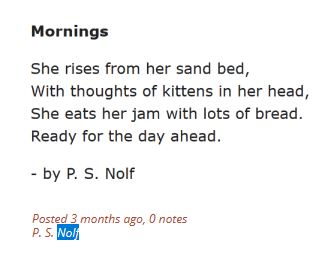
Mornings, a Poem Published on Quatrain Fish

Quatrain Fish only publishes poems of four lines or less.  The site published my "Mornings" about a little girl on the beach.

If you like your poetry in morsel sizes, you should check out this site.

Hark Hark The Dogs of War Do Bark on Scarlet Leaf

Scarlet Leaf Magazine just published my short story "Hark Hark the Dogs of  War Do Bark."  I am writing a book Raising Rough Riders in the White House: Theodore Roosevelt and His Sons Archie and Quentin and Their Pony Algonquin.  While researching the death of Quentin during WW I, I discovered serio-comic maps as both art form and propaganda devices. Examining the 1917 map Hark, Hark, the Dogs Do Bark, I wondered what would happen if the characters could talk.

You can read this story and other pieces of great fiction at:

https://www.scarletleafreview.com/short-stories19/category/ps-nolf

Inviaivlw rABBIT HELP WITH CHAR CREATION

London 1975.  Prince of Wales Theater.  Jimmy Stewart, playing Elwood P. Dowd, and the other cast members enchant me into seeing a six-foot, eight-inch tall pooka or rabbit named Harvey on stage.  I have loved the magic of theater ever since I could afford the price of a ticket.  Some highlights of my appreciation of the theatrical arts include Kevin Spacey (this was a decade before his alleged sexual harassment history hit the news) as Richard III at the Old Vic in London and Vanessa Redgrave and Joely Richardson as mother and daughter in “Lady Windermere’s Fan” at the Theater Royal Haymarket.  My enjoyment of theater is not dependent on movie stars in leading roles.  I adore community productions of “Our Town” and “Tony N Tina’s Wedding.” 

My only attempt behind the proscenium was when another woman and I (students of non-traditional age in a two-week college program in Greece) read the roles of Euelpides and Pisthetairos in Aristophanes’s “The Birds,” a farcical, satirical fantasy written in Greece around 400 BC.   Our version of the play was staged on the Aegean beach on the Greek island of Kos.  I suspect we won the roles because the professors thought our maturity would enable us to handle lines such as “chickenshitter,” “tickling his testicles,” and “with cocks erect.”  We couldn’t, but after a glass of ouzo we were better at pretending. 

         My experience with writing plays is zilch.  So I was perplexed by a class assignment on drama.  What possible use could I have for learning how to write plays?  Then it struck me like a falling medium-arc iodide spotlight.  Since I was having problems writing the scene of Quentin sneaking Algonquin the pony into the boys' bedroom to cheer up his brother Archie who had the measles, I could re-write the pony in the elevator event as a mini-play.  The techniques used in drama should help me to better visualize what was happening.  I am adapting Anne Lamott’s suggestion in Bird By Bird of using a different method of conveying character information, in my case a play instead of a letter, to free me “from the tyranny of perfectionism.”


I read Burroway's Imaginative Writing to determining which techniques of the theater might help me in this restaging.  Since my miniplay needs to occur on a stage, I choose to set it in Archie and Quentin’s bedroom, which requires reviewing floor plans for the White House in 1903.  The set designer needs to sketch the location of windows and doors, style of bedroom furniture, source of light, appropriate props, etc., to help establish mood and period.  Translating the plot into dramatic terms means that the inciting incident is the quarantining of Quentin and Archie to their beds because of measles; exposition can be delivered by two servants explaining the boys’ dissatisfaction with the quarantine; and the point of attack comes when Archie is denied a visit with his pony.
Understanding the design of the set is important so that I can block the movement of the actors.  Does Archie get out of bed to open the curtains?   From where does the pony enter?  As part of the stage directions, I can describe any critical actions that Archie or Quentin perform while reciting a bit of dialog.  Does Archie jump out of bed to greet Algonquin?  Does he stay in bed and let the pony approach him?
A consideration of nonverbal sounds is necessary.  What diegetic sounds, sounds that originate from objects present on the stage, need to be considered?  An important one is the sound of the elevator which could be heard because it abuts the back of the boys’ bedroom.  Other diegetic sounds would be the clip clop of pony hooves down the hall and the opening or closing of drapes.  I choose not to use any nondiegetic sounds until I rewrite the play as a musical.
Burroway presents some “things to remember” about play dialog that I find useful in writing fiction or non-fiction.  Introduce the conflict early so I need to ensure that Archie asks to visit Algonquin close to the beginning of the play.  Dialogue needs to be written so that the actors can speak it in a natural way.  Silences can be used to introduce tension.  The length of the dialog spoken by characters can be varied to retain the listener’s interest.
I sent the pony play to my sister.  Her reactions helped me evaluate what format works well in telling different parts of the story.  Exposition about the measles epidemic slows down the play format but can work well as a written introduction to non-fiction.  The elevator scene would work best in a filmed format since the director can control the frame, angle, close ups, and points of view to focus on the interactions between person and pony.  The mother-sons-pony scene can work well in film, drama, or non-fiction if the format captures the truth of the moment.   
 My sister, who has met my Icelandic horse (remember Algonquin is half Icelandic), identifies the truth of the scene as “Blessi always finds the treats!!!”  Writing the pony in the elevator scene as a play better enabled me to get to the truth of the event.  As Donald Barthelme says, “Truth ... is a hard apple, whether one is throwing it or catching it.”  Apples—and cookies--make it easier to catch the truth of a pony.

The Night Troll on Corvid Queen

What a wonderful way to start off 2020--to be able to read my poem The Night Troll on Corvid Queen. Please take the time to read the other works on this site.  Sarah Chevalier identifies Corvid Queen as the space "to celebrate the magic of feminism and the feminism of magic.  I am happy my poem found a home here.


https://corvidqueen.com/stories/night-troll-ps-nolf


"Showdown at the Strand" is now published

Axe versus whale rib. Sword versus blubber. “Showdown at the Strand” is a retelling of one of the Icelandic sagas using American Western motifs. I wrote this story in honor of the heritage of my Icelandic horse Blessi. I planned to re-enact hunting stranded whales in Iceland by horseback around 1020 AD in a Society for Creative Anachronism event. But something happened so I wrote this story instead.

Chris Herron created an amazing podcast out of this story.  You can listen to the whale of a tale at Tall Tales TV, which was one of the finalists for a 2018 Parsec Award.

Blessi's Poem is Published


Crepe and Penn Literary Magazine included my poem "If a Pony Penned a Poem."  Guess who was the inspiration?  You can read it on page 66 at the following link.

Blessi also asked me to remind everybody that a peanut is a poem to a pony.


Corvid Queen to Publish "The Night Troll"

Up until the past hundred years, most Icelandic horses had to survive on their own over the white, perishing Icelandic winters. Who knows what they saw under the white moon over Iceland?   I wrote a poem "The Night Troll" using that motif.  Corvid Queen is publishing it in January 2020.

In the meantime, here's some lovely film footage of Iceland at night under the moon.  Jakobina Ragnhildur sings "Moonlight Shadow" in Icelandic.  

"Why Do We Write" Published

Page and Spine Showcase published my essay about why authors write.  As Anne Lemott explains, good writing is "telling the truth in an interesting way" which is hard, hard, hard to do "like bathing cats."  Yet still we persist.

https://pagespineficshowcase.com/the-writers-table/why-do-we-write-p-s-nolf

A treatise of Stops, Points, or Pauses--Parentheses as Adornment or Distraction

Faced with another heated, online discussion about grammar--on whether or not the use of parentheses and/or brackets add value to written discourse (and to avoid cleaning the cat litter boxes), I went off to do some research. Thereby, I encountered the 1680 book A treatis [sic] of stops, points, or pauses: and of notes which are used in writing and in print; both very necessary to be well known and the use of each to be carefully taught. Composed for the authors [sic] use, who is a hearty wel-willer [sic] to (and accordingly hath endeavoured the promoting of) the attainments of children, and others, in the tru [sic] spelling, and exact reading of English. I suspect all members of this group could use this title by itself as support for their arguments--regardless of which side they support.

The University of Queensland maintains an ebook version in their library but but it is only accessible to their students. So I had to search for other online references to this treatise.

Bryan Garner in his "Parenthetical Habits: On the use and overuse of parentheses and brackets" (1) provides the only only quotes I can find from A Treatise of Stops, Points, or Pauses. "The parenthesis, he says, is “a Note made of two great Semi-circls, or half Moons; thus, ( ),” adding: “These do, and always must include, or inclose one, or more words of a perfect sense in a Sentence, which may be used, or omitted, and yet the Sense remain intire.” The related marks we call brackets he termed “crotchets,” or “Two Semi-quadrats thus, [ ].” He had little to say about brackets except urging the reader to go find examples in the margins of books, so that “you will thereby be the better enabled to understand their use, wherever else you meet with any.”

Point 1: The discussion of parentheses and brackets can make grammarians crotchety.

Second reference to The Treatise of Stops, Points, or Pauses appears in Alberto Manguel's "Best Punctuation: Point of Order." (2) Here's a lengthy quote illustrating how some writers can make poetry even out of a discussion of grammar.

"Diminutive as a mote of dust, a mere peck of the pen, a crumb on the keyboard, the full stop -- the period -- is the unsung legislator of our writing systems. Without it, there would be no end to the sorrows of young Werther, and the travels of the Hobbit would have never been completed. Its absence allowed James Joyce to weave ''Finnegans Wake'' into a perfect circle, and its presence made Henri Michaux compare our essential being to this dot, ''a dot that death devours.'' It crowns the fulfillment of thought, gives the illusion of conclusiveness, possesses a certain haughtiness that stems, like Napoleon's, from its minuscule size. Anxious to get going, we require nothing to signal our beginnings, but we need to know when to stop: this tiny memento mori reminds us that everything, ourselves included, must one day come to a halt. As an anonymous English teacher suggested in the 1680 ''Treatise of Stops, Points or Pauses,'' a full stop is ''a Note of perfect Sense, and of a perfect Sentence.''"

Manguel concludes his essay with "'No iron,' Isaac Babel wrote, 'can stab the heart with such force as a full stop put just at the right place.'"

Point 2: Discussions about grammar can lead to murder.

Most grammar searches usually end up reductio ad absurdum. So let's conclude with Megan Garber's "Screamer, Slammer, Bang...and 15 Other Ways to Say Exclamation Point." (3) Many authors, instructors, and advisors on the craft of writing deplore its use. Garber writes that "The exclamation mark, I am trying to say, is the cockroach of the punctuation world. And that's particularly so in the digital space, which so infamously encourages its proliferation (!!!!). The exclamation will, despite and because of all the things that make it terrible, survive us all." Here are the various synonyms used for the exclamation point through the centuries : admiration mark, bang, Christer, control, dembanger, dog's cock, dog's dick, gasper, pling, screamer, shriekmark, shout pole, slammer, smash, soldier, spark-spot, startler, wonderer.

Point 3: Discussion of proper use of grammar can be an extreme waster of time leading to infinite delay in putting off cleaning cat litter boxes.

Sources:
(1) http://www.abajournal.com/magazine/article/garner_parenthetical_habits
(2) https://www.nytimes.com/1999/04/18/magazine/best-punctuation-point-of-order.html
(3) https://www.theatlantic.com/technology/archive/2013/04/screamer-slammer-bang-and-15-other-ways-to-say-exclamation-point/274687/

Nonfiction Publications

Theodore Roosevelt Riding with Theodore Roosevelt in Equus , April 2018. Republished by Equus online September 20, 2023. Republished by Equ...